- Forecast Value (2036): 4.5 Bn
- CAGR (2036): 17.5%
What is the cold plunge tubs market forecast to be worth by 2036?
USD 0.9 billion in 2026 to USD 4.5 billion by 2036, at 17.5% CAGR.
- The cold plunge tubs market crossed an estimated valuation of USD 0.8 billion in 2025. Revenue is estimated at USD 0.9 billion in 2026 and is projected to reach USD 4.5 billion by 2036.
- The market is forecast to record 17.5% CAGR during 2026 to 2036 as home recovery rooms, boutique fitness studios and spa contrast circuits add controlled cold-water systems.
- The forecast reflects a small equipment base moving into repeat-use residential and commercial settings. Chiller-equipped tubs should gain faster than ice-filled barrels because users want stable temperature, easier sanitation and fewer daily setup steps.
- Direct online brands should also support early scale by explaining electrical load, delivery, water care and warranty coverage before purchase.
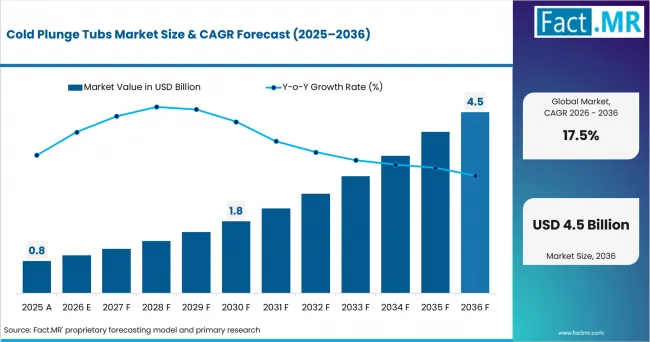
Cold Plunge Tubs Market Market Value Analysis | Source: Fact.MR
What are the defining numbers behind cold plunge tubs growth?
USD 3.60 billion absolute opportunity by 2036. The United States, Australia and Canada lead the country view.
- Demand Drivers in the Market
- Chiller-equipped tubs reduce daily ice handling, which changes cold immersion from an occasional activity into a repeat home routine.
- Fitness clubs add cold plunge rooms because recovery space supports higher membership tiers and longer facility visits.
- Spa and hotel buyers pair cold water with heat rooms because contrast circuits raise appointment value and improve space use.
- Water sanitation has become a buying gate because shared tubs need cleaner water, fewer drain cycles and clearer service terms.
- Key Segments Analyzed
- By Capacity: Single Person tubs are expected to account for 68.0% share in 2026 because most purchases are residential or single-session commercial use.
- By Temperature System: Electric Chillers are projected to capture 64.0% share in 2026 as buyers move away from loose ice replenishment.
- By Product Type: Chiller Tubs are estimated to hold 58.0% share in 2026 because temperature control and filtration are now core buyer requirements.
- By Buyer Type: Home Users are likely to represent 52.0% share in 2026 as recovery products shift into garages and patios.
- By Sales Channel: Direct Online is forecast to secure 49.0% share in 2026 because brands explain installation and service coverage better on their own sites.
- By Installation: Portable Units are anticipated to hold 47.0% share in 2026 since renters and first-time buyers prefer lower installation risk.
- By End Use: Recovery Fitness is expected to contribute 41.0% share in 2026 because post-workout soreness remains the clearest reason to buy.
- Analyst Opinion
- Shambhu Nath Jha, Principal Analyst at Fact.MR states, "I see cold plunge tubs as a water-control business first. The buyer asks three practical questions. How cold does it stay, how clean does it stay and who services it when a paid recovery room is full?"
- Strategic Implications
- Cold plunge suppliers should publish cooling-rate and water-care evidence because buyers compare use cost after the first month.
- Commercial sellers need service-level terms for filters and pumps. Leak response and chiller replacement terms also need to be defined.
- Home brands should simplify electrical and drainage guidance because installation hesitation delays checkout.
- Spa and hotel suppliers can use contrast-therapy packages to sell a room concept instead of only a tub.
Cold-water immersion tubs with chillers, filtration, insulation and sanitation systems form the core of this market. National Sanitation Foundation International published NSF/ANSI/CAN 50 requirements for cold plunges in February 2026. This supports demand for suppliers that can document water-care performance, shared-use hygiene and commercial safety expectations before gyms, spas and hotels install tubs.
The United States is projected to record 18.9% CAGR through 2036 as home gym density and premium recovery retail support faster adoption. Australia is expected to expand at 18.2% CAGR because outdoor sport culture and high personal wellness spending support patio, club and studio installations. Canada is forecast to grow at 17.8% CAGR as cold-climate wellness behavior and home recovery interest support compact tubs. The United Kingdom is expected to advance at 17.2% CAGR as boutique fitness and sauna-cold plunge social wellness support commercial rooms. Germany is projected to rise at 16.6% CAGR as fitness club density and regulated wellness operations support documented water-care systems. Japan is forecast to expand at 16.1% CAGR as bathing culture and compact premium recovery formats support smaller tubs. China is expected to record 15.4% CAGR as sports facility expansion and premium wellness retail support club-led demand.
How does the cold plunge tubs market break down by segment?
Single Person capacity leads at 68.0%. Electric Chillers follow with 64.0% share in 2026.
Which product type dominates?
Chiller Tubs hold 58.0% share in 2026.
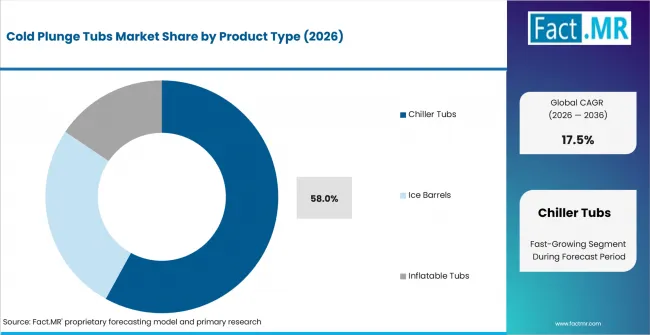
Cold Plunge Tubs Market Analysis By Product Type | Source: Fact.MR
Chiller Tubs are expected to hold 58.0% share in 2026 because repeat users want fixed water temperature without buying ice. The category also gives brands more room to sell filters and service kits after the original purchase.
Home recovery buyers often compare chiller tubs with functional fitness equipment when allocating space inside garages and spare rooms.
Which temperature system dominates?
Electric Chillers hold 64.0% share in 2026.
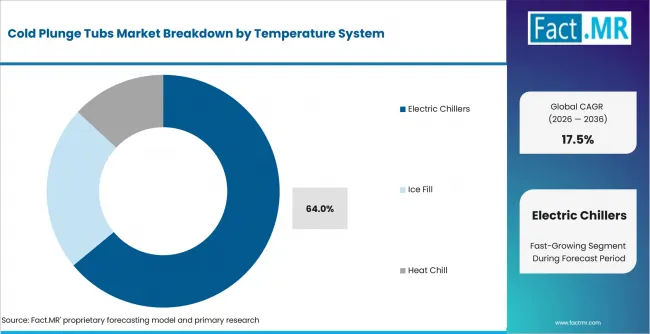
Cold Plunge Tubs Market Analysis By Temperature System | Source: Fact.MR
Electric Chillers are projected to account for 64.0% share in 2026 because temperature stability is the clearest upgrade over ice-filled tubs. Commercial products now compete on cooling power and water-management support.
Filtration, pumps and covers also connect cold plunge systems with pool and spa accessories because buyers judge water care before repeat use.
Which installation model dominates?
Portable Units hold 47.0% share in 2026.
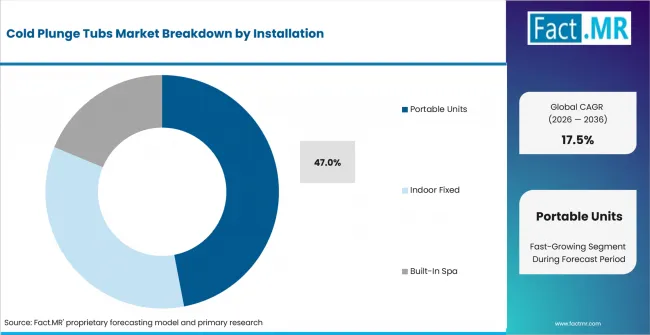
Cold Plunge Tubs Market Analysis By Installation | Source: Fact.MR
Portable Units are forecast to account for 47.0% share in 2026 as first-time buyers avoid construction work and permanent plumbing. Inflatable and barrel units keep entry prices lower.
This installation logic places cold immersion next to aqua gym equipment in commercial sites where water systems must remain easy to clean.
Which buyer type dominates?
Home Users hold 52.0% share in 2026.
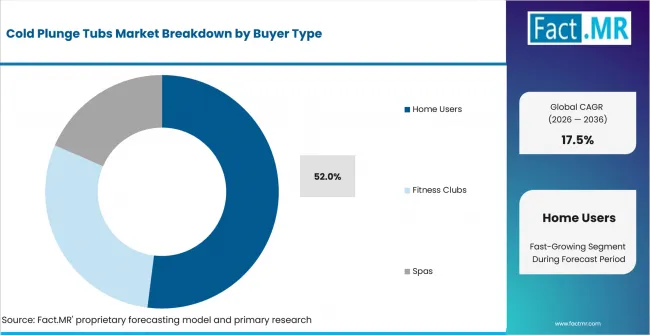
Cold Plunge Tubs Market Analysis By Buyer Type | Source: Fact.MR
Home Users are estimated to represent 52.0% share in 2026 because consumer recovery culture moved into private homes after gym and creator-led exposure. Financing offers matter because premium tubs can cost more than ordinary gym equipment.
Commercial buyers connect cold immersion to fitness recovery services when they sell paid sessions rather than product ownership.
Which sales channel dominates?
Direct Online holds 49.0% share in 2026.
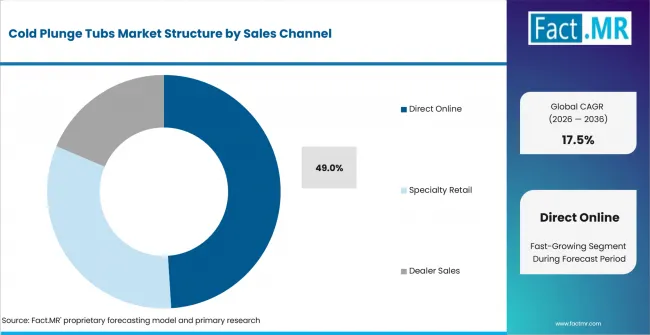
Cold Plunge Tubs Market Analysis By Sales Channel | Source: Fact.MR
Direct Online is likely to hold 49.0% share in 2026 because suppliers need space to explain electrical load and temperature range. Delivery and water-care rules also require clear product pages.
Specialty dealers still matter when buyers treat tubs as sport accessories that must match a training room layout.
Which end use dominates?
Recovery Fitness holds 41.0% share in 2026.
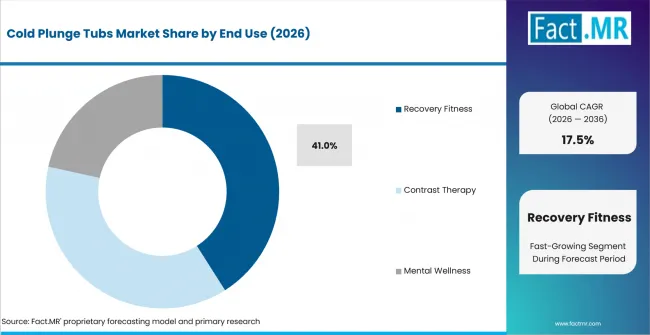
Cold Plunge Tubs Market Analysis By End Use | Source: Fact.MR
Recovery Fitness is expected to account for 41.0% share in 2026 because the clearest purchase reason is post-exercise soreness and routine recovery. A 2026 Frontiers review found that cold-water immersion reduced soreness compared with passive rest.
Recovery positioning often sits beside sports nutrition because buyers treat both as parts of performance routines.
Which capacity type dominates?
Single Person tubs hold 68.0% share in 2026.
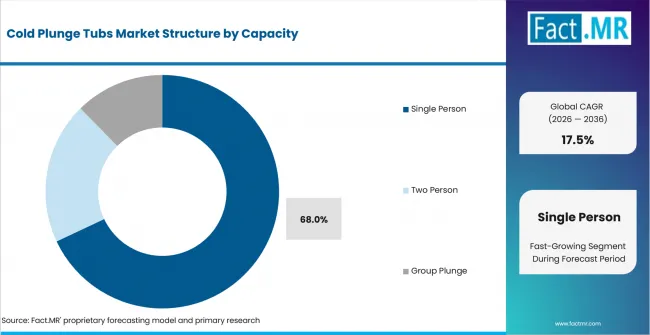
Cold Plunge Tubs Market Analysis By Capacity | Source: Fact.MR
Single Person tubs are anticipated to account for 68.0% share in 2026 because cold immersion is usually a timed solo session. Team and spa tanks remain useful in heavy-use venues, but the one-person format fits home spaces better.
Single-person formats are specified near gym equipment when clubs build compact recovery rooms.
What is accelerating cold plunge tubs demand, and what is holding it back?
Home recovery rooms and premium fitness clubs support demand. High upfront cost, service risk and evidence limits restrain wider use.
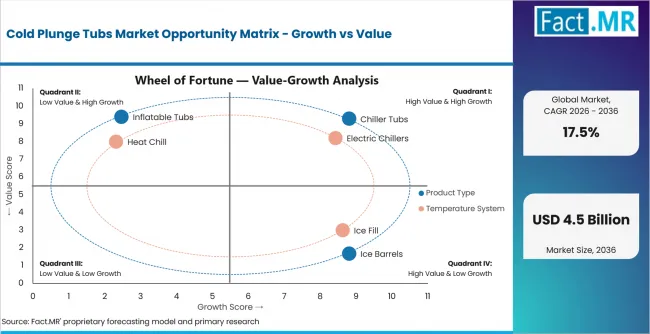
Cold Plunge Tubs Market Opportunity Matrix Growth Vs Value | Source: Fact.MR
Cold plunge tubs gained traction because recovery shifted from a professional sports service into a home and boutique fitness routine. The mechanism is simple. A chiller and filtration package removes the work of daily ice use, so the product becomes easier to repeat.
Commercial operators add tubs when they can price recovery rooms as a higher-value service. Health & Fitness Association data showed nearly 7.0 billion visits to United States gyms in 2025. High facility traffic gives clubs a reason to add visible recovery equipment, but it also increases the need for sanitation and service support.
Wider use is constrained by price, maintenance and buyer uncertainty around benefits. The research evidence is useful but not unlimited, so suppliers need to avoid overclaiming. Water hygiene, chiller noise and warranty response can decide whether a buyer repeats the purchase or recommends the product.
Where do the biggest cold plunge tubs opportunities sit?
Home recovery rooms, boutique fitness recovery and spa contrast circuits create the clearest commercial routes.
- Home Recovery Rooms: Suppliers can sell compact tubs and lower-noise chillers to households that already buy recovery tools. App-based guidance can link tub timing with home fitness app routines when brands want recurring user engagement.
- Boutique Fitness Recovery: Studio operators can add cold plunge sessions to premium memberships when water-care rules and service response are documented. Connected control panels also place cold tubs beside connected fitness equipment where operators need usage tracking and remote diagnostics.
- Spa and Hotel Contrast Circuits: Hospitality buyers can pair plunge tubs with saunas and massage rooms to raise time-on-site and wellness package value.
Which countries are scaling cold plunge tubs fastest?
United States 18.9% CAGR, Australia 18.2% CAGR, Canada 17.8% CAGR, United Kingdom 17.2% CAGR, Germany 16.6% CAGR, Japan 16.1% CAGR, China 15.4% CAGR.
Based on regional analysis, the cold plunge tubs market is segmented into North America and Western Europe. East Asia and Oceania are also covered. Latin America and Middle East and Africa complete the regional scope.
.webp "Top Country Growth Comparison Cold Plunge Tubs Market Cagr (2026 2036)")
Top Country Growth Comparison Cold Plunge Tubs Market Cagr (2026 2036) | Source: Fact.MR
| Country | CAGR |
|---|---|
| United States | 18.9% |
| Australia | 18.2% |
| Canada | 17.8% |
| United Kingdom | 17.2% |
| Germany | 16.6% |
| Japan | 16.1% |
| China | 15.4% |
Source: Fact.MR analysis. Updated Jun 24, 2026
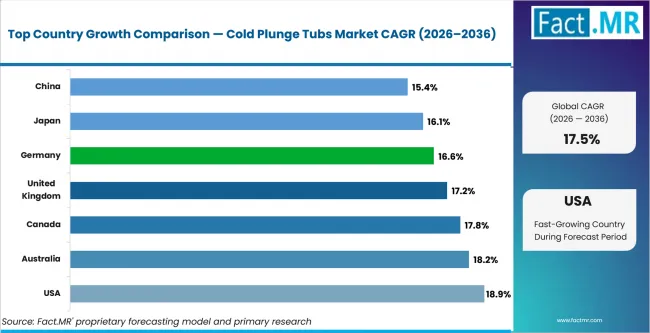
Cold Plunge Tubs Market Cagr Analysis By Country | Source: Fact.MR
What powers the United States lead?
18.9% CAGR, supported by home gym density and premium recovery retail.
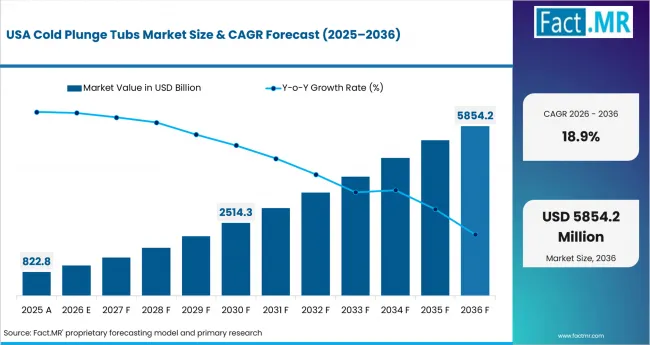
Cold Plunge Tubs Market Country Value Analysis | Source: Fact.MR
The United States has the deepest consumer base for early home recovery equipment. Sports & Fitness Industry Association data shows 247.1 million active Americans in 2024, while fitness facility membership reached a record base in 2025. That mix gives suppliers both home buyers and commercial buyers. Brands that pair financing, service and sanitation guidance should gain better conversion in this market.
Why does Australia matter?
18.2% CAGR, driven by outdoor sport culture and high personal wellness spending.
Australia’s buyer base is shaped by year-round outdoor sport and high use of public spaces. The Australian Sports Commission reported that 85.0% of Australian adults were active in its latest AusPlay data. That activity base supports recovery products for home patios, clubs and training studios. Heat exposure and outdoor placement also make insulation and chiller reliability important in supplier selection.
What supports Canada’s outlook?
17.8% CAGR, attributable to cold-climate wellness behavior and home recovery interest.
Canada’s buyer base is familiar with cold exposure, but equipment purchases still depend on price and available space. The Future of Sport in Canada report said sport and recreation infrastructure is central to physical activity delivery. The paid recovery route is therefore concentrated in active households and boutique studios. Financing and compact vertical tubs should matter more than large luxury installations.
How is the United Kingdom scaling cold plunge demand?
17.2% CAGR, driven by boutique fitness and sauna-cold plunge social wellness.
The United Kingdom’s cold plunge pathway is linked to fitness participation and spa culture rather than large home pools. Sport England reported that 30.0 million adults in England met weekly activity guidelines in the year to November 2024. This creates a buyer base for gyms and wellness clubs. Suppliers that simplify maintenance for compact commercial rooms should be better placed.
What makes Germany important?
16.6% CAGR, supported by the fitness club base and regulated wellness operations.
Germany has a strong club base and a developed sauna culture, which supports contrast-therapy purchasing. The Health & Fitness Association reported 11.7 million fitness facility members in Germany in 2024. Buyers are likely to compare service coverage and hygiene documentation before design. This keeps the market practical rather than fashion-led.
Why is Japan a relevant commercial market?
16.1% CAGR, led by bathing culture and compact premium recovery formats.
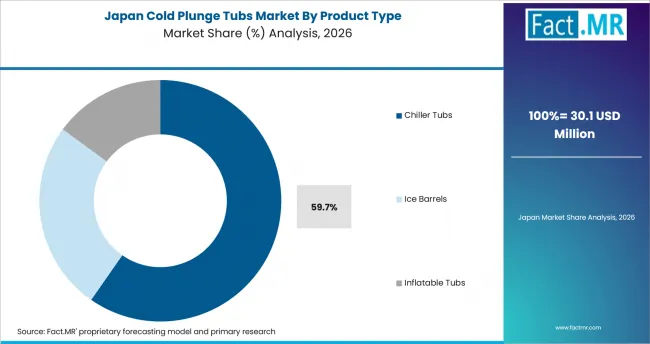
Cold Plunge Tubs Market Japan Market Share Analysis By Product Type | Source: Fact.MR
Japan has a cultural link to bathing and temperature contrast, but space limits shape product design. The Sasakawa Sports Foundation survey found that 69.8% of people participated in sports and physical activities at least once in 2024. Compact and quiet tubs should therefore suit apartments and small gyms. Suppliers need lower-footprint formats to move beyond luxury buyers.
How does China create a scaling route?
15.4% CAGR, backed by sports facility expansion and premium wellness retail.
China’s growth case is tied to sports infrastructure and premium urban wellness retail. The State Council reported over 4.84 million sports venues in 2024, including 152,000 gyms. Cold plunge tubs should enter through clubs and high-income home buyers first. Local distribution and after-sales service are likely to decide how quickly premium products move outside large cities.
Who leads the cold plunge tubs landscape?
Plunge, Ice Barrel and Sun Home Saunas lead through product visibility. Renu Therapy, Brass Monkey Health and Nordic Wave add premium and regional depth.
Cold Plunge Tubs Market Analysis By Company | Source: Fact.MR
Competition is split between direct-to-consumer recovery brands, premium wellness equipment suppliers and commercial spa-system sellers. The competitive field remains fragmented, which leaves room for regional brands with strong service coverage.
Supplier positioning overlaps with broader sports equipment when buyers compare durability, warranty and delivery support.
Product capability is now measured by cooling range, chiller horsepower, sanitation method, sound level and service response. Plunge emphasizes commercial water controls and compliance features. Sun Home Saunas competes with stainless steel tubs and premium contrast wellness bundles. Brass Monkey Health sells ice-generating units for buyers who want colder sessions.
Smaller brands can win on price and visual design, but larger contracts favor suppliers that document water care and electrical requirements. Commercial buyers also want proof that filters, pumps and chillers can handle repeated daily sessions. That favors companies with service networks and clear replacement-parts availability.
The best-placed suppliers through 2036 should sell the complete operating routine. That means tub, chiller, filter plan, cover, setup guide and service route. A brand that only sells a shell or barrel can win first-time buyers, but it may lose repeat commercial orders.
Which companies are the key players?
Plunge and Ice Barrel are key players. Sun Home Saunas, Renu Therapy and Brass Monkey Health are also profiled. Redwood Outdoors and Nordic Wave complete the company set.
- Plunge
- Ice Barrel
- Sun Home Saunas
- Renu Therapy
- Brass Monkey Health
- Redwood Outdoors
- Nordic Wave
Bibliography
- [1] Australian Sports Commission. (2025, May 30). Australians are redefining the way they play. Australian Sports Commission.
- [2] Brass Monkey Health. (2025, January 3). The growing global demand for ice baths and cold plunges. Brass Monkey Health.
- [3] Government of Canada, Department of Canadian Heritage. (2026, March 24). Chapter 2: Why sport is important to Canadians and Canada. Government of Canada.
- [4] Frontiers in Sports and Active Living. (2026, May 7). Effects of cold-water immersion at different body regions on post-exercise muscle damage recovery: A systematic review and meta-analysis. Frontiers in Sports and Active Living.
- [5] Health & Fitness Association. (2026, April 9). 81 million Americans were members of a fitness facility in 2025, new HFA report finds. Health & Fitness Association.
- [6] Health & Fitness Association. (2025, May 25). Europe report shows fitness industry recovery. Health & Fitness Association.
- [7] NSF International. (2026, February 18). NSF/ANSI/CAN 50 requirements for cold plunges. NSF International.
- [8] Renu Therapy. (2025, March 18). Predictions for cold plunge tanks: What’s next in 2025? Renu Therapy.
- [9] Sasakawa Sports Foundation. (2024, December 31). The 2024 SSF National Sports-Life Survey. Sasakawa Sports Foundation.
- [10] Sport England. (2025, April 24). Record numbers playing sport and taking part in physical activity. Sport England.
- [11] Sports & Fitness Industry Association. (2025, February 27). SFIA’s Topline Participation Report shows 247.1 million Americans were active in 2024. Sports & Fitness Industry Association.
- [12] State Council of the People’s Republic of China. (2025, March 19). China’s per capita sports venue area reaches 3 sq m in 2024: Official data. State Council of the People’s Republic of China.
- [13] Sun Home Saunas. (2026, June 11). Best cold plunge tubs of 2026: 7 brands compared. Sun Home Saunas.
This Report Addresses
- Strategic intelligence on cold plunge tubs across Product Type, Temperature System, Installation and Buyer Type.
- Segment analysis covering Chiller Tubs, Electric Chillers, Portable Units, Home Users and Direct Online.
- Regional outlook covering United States, Australia, Canada, United Kingdom, Germany, Japan and China.
- Competitive analysis of Plunge, Ice Barrel and Sun Home Saunas as key players. Renu Therapy, Brass Monkey Health and Redwood Outdoors are also profiled. Nordic Wave completes the company set.
- Product assessment covering Chiller Tubs, Ice Barrels, Inflatable Tubs, Built-In Plunges and Combo Units.
- Sanitation assessment covering filtration, shared-use water care, chiller reliability and commercial safety expectations.
- Source-led market sizing using provider counts, pricing checks, fitness participation data, product specifications and buyer interviews.
What does the cold plunge tubs market cover?
Home and commercial cold-immersion tubs sold with chillers, insulation, pumps, filtration and sanitation systems.
The market covers paid equipment revenue from cold-water immersion tubs used for recovery and contrast therapy. Wellness routines are also included. Stand-alone tubs and barrel tubs are included with inflatable units and built-in plunge systems. Chillers, pumps and filters are counted when sold as part of the tub system.
What is included in the scope?
Chiller-equipped tubs and ice-ready barrels are included. Commercial tubs and water-care accessories are also included.
The scope includes direct-to-consumer residential tubs and commercial installations for gyms. Spas, hotels and sports teams are also covered. Physiotherapy centers are covered when the buyer purchases equipment. Replacement filters and covers are included when bundled with the cold plunge system.
What is excluded from the scope?
Saunas and hot tubs are excluded. Cryotherapy chambers and facility service revenue without equipment sales are also excluded.
The scope excludes ordinary hot tubs without controlled cold immersion. It also excludes sauna revenue and cryotherapy cabins. Single-use ice sales and general pool construction are outside scope. Membership fees from recovery clubs are excluded unless the revenue is tied to tub leasing or maintenance service.
How was the analysis built?
100+ sources and 35+ company or distributor pages. 20+ countries were checked with 18+ buyer and supplier interviews.
- Primary Research:
- Interviews covered residential buyers and wellness studio operators. Gym owners, spa consultants and equipment distributors were also included.
- Desk Research:
- Desk research reviewed sports participation data and fitness association releases. Official sports venue data, product pages and peer-reviewed cold-water immersion research were checked.
- Market-Sizing and Forecasting:
- Forecasting used provider counts and average selling prices. Commercial installation assumptions and replacement accessory revenue supported the model.
- Data Validation and Update Cycle:
- Estimates were checked against the pool and spa equipment benchmark and fitness membership evidence. Supplier portfolios and 2026 product pricing were also reviewed.
Segmentation
What is the report's scope and coverage?
Cold Plunge Tubs Market Breakdown By Product Type, Temperature System, And Region | Source: Fact.MR
| Attribute | Details |
|---|---|
| Quantitative Units | USD Billion in 2026 to USD Billion by 2036 at CAGR |
| Market Definition | Cold-water immersion tubs with chillers, filtration, insulation and sanitation systems for home and commercial recovery use |
| Product Type | Chiller Tubs, Ice Barrels, Inflatable Tubs, Built-In Plunges, Combo Units |
| Temperature System | Electric Chillers, Ice Fill, Heat Chill, Integrated Ice, Hybrid Systems |
| Installation | Portable Units, Indoor Fixed, Outdoor Fixed, Built-In Spa, Custom Builds |
| Buyer Type | Home Users, Fitness Clubs, Spas, Sports Teams, Hotels |
| Sales Channel | Direct Online, Specialty Retail, Dealer Sales, Commercial Bids, Wellness Studios |
| End Use | Recovery Fitness, Contrast Therapy, Mental Wellness, Luxury Wellness, Physiotherapy |
| Capacity | Single Person, Two Person, Group Plunge, Team Tanks |
| Regions Covered | North America, Western Europe, East Asia, Oceania, Latin America, Middle East and Africa |
| Countries Covered | United States, Australia, Canada, United Kingdom, Germany, Japan and China |
| Key Companies Profiled | Plunge, Ice Barrel, Sun Home Saunas, Renu Therapy, Brass Monkey Health, Redwood Outdoors and Nordic Wave |
| Forecast Period | 2026 to 2036 |
| Approach | Hybrid top-down and bottom-up approach using provider counts, pricing checks, fitness participation data, product specifications and buyer interviews |
Source: Fact.MR analysis. Updated Jun 24, 2026
How is the market segmented?
-
By Product Type:
- Chiller Tubs
- Ice Barrels
- Inflatable Tubs
- Built-In Plunges
- Combo Units
-
By Temperature System:
- Electric Chillers
- Ice Fill
- Heat Chill
- Integrated Ice
- Hybrid Systems
-
By Installation:
- Portable Units
- Indoor Fixed
- Outdoor Fixed
- Built-In Spa
- Custom Builds
-
By Buyer Type:
- Home Users
- Fitness Clubs
- Spas
- Sports Teams
- Hotels
-
By Sales Channel:
- Direct Online
- Specialty Retail
- Dealer Sales
- Commercial Bids
- Wellness Studios
-
By End Use:
- Recovery Fitness
- Contrast Therapy
- Mental Wellness
- Luxury Wellness
- Physiotherapy
-
By Capacity:
- Single Person
- Two Person
- Group Plunge
- Team Tanks
-
By Region:
- North America
- United States
- Canada
- Mexico
- Latin America
- Brazil
- Argentina
- Rest of Latin America
- Europe
- Germany
- United Kingdom
- France
- Italy
- Spain
- Rest of Europe
- Asia Pacific
- China
- India
- Japan
- South Korea
- Australia
- ASEAN
- Middle East and Africa
- GCC Countries
- South Africa
- UAE
- Rest of Middle East and Africa
- North America
Frequently Asked Questions
How large is the Cold Plunge Tubs Market expected to be in the near term?
What is the long term outlook for the Cold Plunge Tubs Market?
How fast is the Cold Plunge Tubs Market expected to grow?
Which product type is expected to dominate the market?
What is the preferred temperature system in the market?
Which country is likely to showcase the strongest growth momentum?
What is the growth outlook for Australia?
How is Canada contributing to market growth?
What is the key factor driving market expansion?
What is the primary challenge facing the market?
Who worked on this report


Preview the report firsthand - request a free sample
Free SampleGet the brochure for pricing and purchase details
Download PDF