- Forecast Value (2036): 3.7 Bn
- CAGR (2036): 3.6%
What is the screen protector films market forecast to be worth by 2036?
USD 2.6 billion in 2026 to USD 3.7 billion by 2036, at 3.6% CAGR.
- The screen protector films market crossed a valuation of USD 2.46 billion in 2025.
- Sales are expected to increase from USD 2.6 billion in 2026 to USD 3.7 billion by 2036.
- The market is forecast to record 3.6% CAGR from 2026 to 2036 as replacement purchases remain frequent across smartphones, tablets, laptops and connected displays.
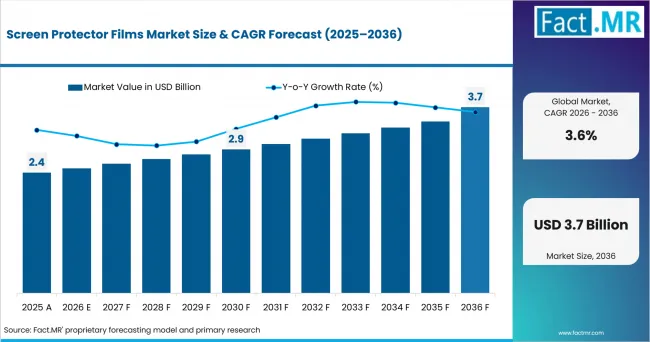
Screen Protector Films Market Market Value Analysis | Source: Fact.MR
What are the defining numbers behind screen protector films growth?
USD 1.1 billion absolute opportunity by 2036, led by East Asia and South Asia.
- Demand Drivers in the Market
- Replacement sales are supported by frequent screen damage, resale protection and low purchase friction in online channels.
- Original equipment manufacturer pre-applied films are gaining attention due to foldable displays and premium device launch programs.
- Enterprise buyers specify privacy films to reduce shoulder-surfing risk on laptops and tablets.
- Repair stores use cut-on-demand film systems to serve older models without holding large inventory.
- Key Segments Analyzed
- By Product Type: PET film is estimated to hold 36.0% share in 2026 due to low cost and broad device compatibility.
- By Device Type: Smartphones are projected to account for 63.0% share in 2026 due to high replacement frequency.
- By Function: Scratch protection is expected to hold 44.0% share in 2026 due to daily handling damage.
- By Channel: E-commerce is forecast to capture 33.0% share in 2026 due to model-specific buying and bundled accessory sales.
- By Region: East Asia is projected to account for 41.0% share in 2026 due to device manufacturing and accessory conversion scale.
- Analyst Opinion at Fact.MR
- Shambhu Nath Jha, Senior Analyst at Fact.MR, states, "Screen protector films are now judged by fit accuracy, touch response and installation success. Retailers want films that can be matched to a new device quickly. Suppliers that combine material clarity with model coverage and channel support are better placed than sellers of generic clear sheets."
- Strategic Implications
- Film converters should build faster die libraries for new smartphones and foldable devices.
- Accessory brands need clearer separation between PET, TPU and privacy film claims.
- Telecom and repair stores should use installation tools to reduce return rates from dust and misalignment.
- B2B suppliers can position privacy films as a data-protection accessory for mobile workforces.
Screen protector films form the removable protective layer used over display surfaces. International Telecommunication Union data shows 112 mobile-cellular subscriptions per 100 inhabitants in 2024. [1] This confirms a large installed device base that supports replacement purchases for polyethylene terephthalate film, thermoplastic polyurethane hydrogel film and privacy film. Related polyester film demand also supports supply of clear and coated layers used in display protection.
India is expected to expand at 5.3% CAGR through 2036 due to mobile phone manufacturing scale and aftermarket replacement. China is projected to record 4.6% CAGR through 2036 as smartphone production and local accessory conversion remain high. The United States is forecast to advance at 3.7% CAGR through 2036 as premium accessory bundles support replacement demand. South Korea is expected to post 3.6% CAGR through 2036 as foldable display expertise supports softer film formats. Japan, Germany and the United Kingdom show steadier growth because buyers place higher weight on fit, clarity and installation reliability.
How does the screen protector films market break down by segment?
PET film leads at 36.0%; smartphones lead at 63.0%.
Which product type dominates?
PET film holds 36.0% share in 2026.
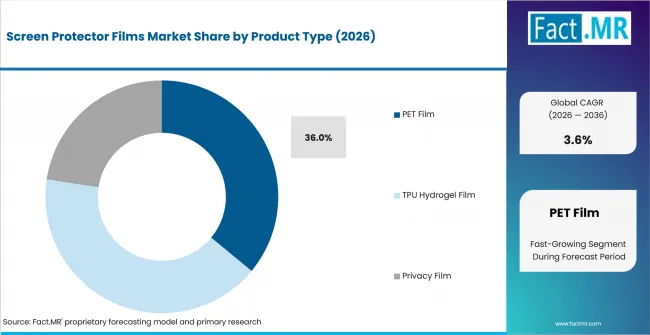
Screen Protector Films Market Analysis By Product Type | Source: Fact.MR
PET film leads because it gives a low-cost base for clear and anti-scratch protectors. It also works with high-volume cutting, easy packaging and broad accessory retail. The segment is estimated to hold 36.0% share in 2026. TPU hydrogel film gains share in foldable and curved displays where flexibility matters more than rigid impact protection. The wider plastic film value chain supports low-cost feedstock and coating options for accessory converters.
Which device type dominates?
Smartphones hold 63.0% share in 2026.
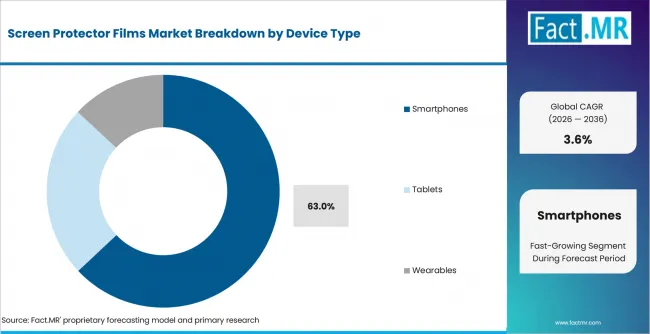
Screen Protector Films Market Analysis By Device Type | Source: Fact.MR
Smartphones lead due to high handling frequency and shorter replacement cycles. International Telecommunication Union data shows that 82% of individuals aged 10 years or older owned a mobile phone in 2025. [2] The installed base keeps repeat demand concentrated in phone protectors before tablets, laptops and wearables. Accessory bundles also link phone films with cases and camera accessories. Mobile imaging accessories such as smartphone gimbal products show how smartphone use continues to support adjacent add-on purchases.
Which function dominates?
Scratch protection holds 44.0% share in 2026.
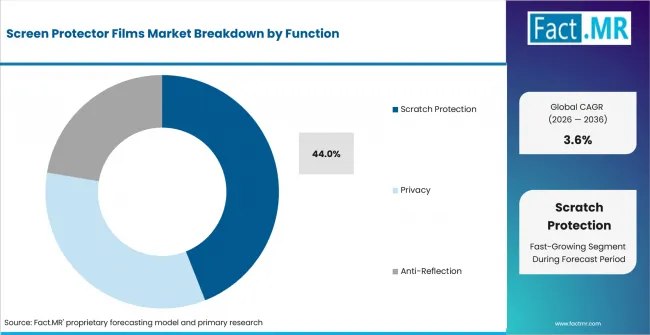
Screen Protector Films Market Analysis By Function | Source: Fact.MR
Scratch protection remains the first purchase reason because users want to prevent pocket abrasion and resale-value loss. The function is expected to hold 44.0% share in 2026. Privacy, glare control and blue-light filtering are smaller but higher-value functions. Buyers choose anti-glare film when outdoor readability or long screen time is part of the purchase decision.
Which channel dominates?
E-commerce holds 33.0% share in 2026.
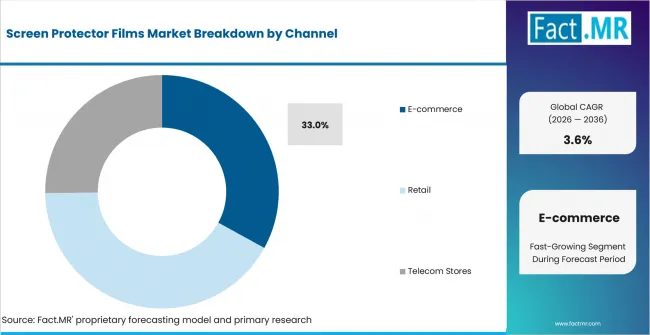
Screen Protector Films Market Analysis By Channel | Source: Fact.MR
E-commerce leads due to model-specific search behavior and direct-to-consumer bundles. Buyers compare compatibility, frame tools and warranty terms before checkout. The channel is forecast to hold 33.0% share in 2026. Physical retail still matters when installation quality influences satisfaction and return rates.
What is accelerating screen protector film demand, and what is holding it back?
Device replacement and privacy requirements support demand; cheap rigid glass and installation failures restrain it.
The main driver is workplace privacy. Privacy films are specified when laptops and tablets are used in offices, travel settings and field service. This supports B2B purchasing beyond consumer phone protection. The same purchasing logic extends to display-surface categories such as coated glass and treated optical layers.
The main restraint is low-priced tempered glass substitution. Many consumers compare film protectors with low-cost glass protectors at the point of sale. Films need clearer claims around touch sensitivity and curved edge coverage to avoid being treated as the cheaper alternative.
Installation defects also hold back repeat purchases. Dust, bubbles and edge lifting can turn a small accessory into a return issue. Brands that supply alignment frames and trained retail installation can reduce that problem better than brands that only ship loose films.
Where do the biggest screen protector film opportunities sit?
Privacy films, foldable-device films and cut-on-demand retail programs.
- Privacy Film Programs: Enterprise buyers can link privacy films with visual-data protection needs. The same procurement logic supports laptop, tablet and field-device fleets.
- Foldable Protection: TPU hydrogel films fit foldable displays better than rigid glass. This gives material suppliers a clearer route into premium device programs.
- Retail Cutting Systems: ZAGG says its InvisibleShield On Demand system stores more than 2,500 device designs in the cloud and updates them automatically. [12] This favors stores that want lower inventory risk.
- B2B Display Integration: Industrial HMI and vehicle screens need protection before field use. The opportunity links screen protector films with durable high performance films used in industrial and transport settings.
Which countries are scaling screen protector films fastest?
India 5.3%, China 4.6%, United States 3.7%, South Korea 3.6%, Japan 3.2%, Germany 3.1%, United Kingdom 3.0%.
Based on regional analysis, the screen protector films market is segmented into East Asia, North America, Europe, South Asia, Latin America and Middle East and Africa.
| Country | CAGR |
|---|---|
| India | 5.3% |
| China | 4.6% |
| United States | 3.7% |
| South Korea | 3.6% |
| Japan | 3.2% |
| Germany | 3.1% |
| United Kingdom | 3.0% |
Source: Fact.MR analysis. Updated Jun 25, 2026
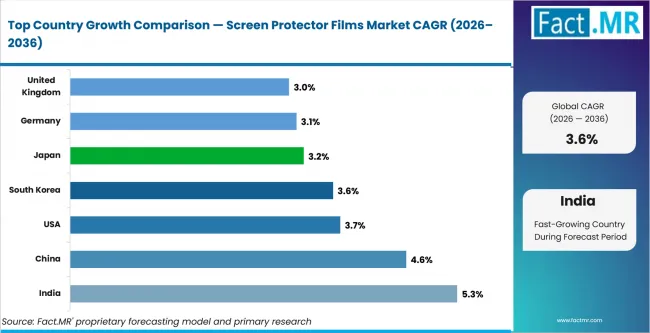
Screen Protector Films Market Cagr Analysis By Country | Source: Fact.MR
What is powering India’s lead?
5.3% CAGR, supported by mobile-phone manufacturing and export scale.
India is expected to expand at 5.3% CAGR through 2036 due to device manufacturing scale and aftermarket replacement. The Press Information Bureau, Government of India states that mobile phone production reached ₹5.45 lakh crore in FY2024-25. [3] That production base improves local availability of accessory conversion, packaging and retail distribution. Suppliers that serve both OEM accessories and online replacement channels can gain stronger access here.
How is China retaining scale?
4.6% CAGR, backed by handset assembly and local accessory conversion.
China has the largest device production ecosystem in the market. The State Council of the People’s Republic of China reported that China produced 1.27 billion smartphones in 2025. [4] China is projected to record 4.6% CAGR through 2036 due to domestic smartphone demand and export-linked accessory supply. Suppliers also connect film development to display-adjacent categories such as OLED display materials and automotive surfaces.
What supports the United States outlook?
3.7% CAGR, supported by high smartphone ownership and premium accessory attachment.
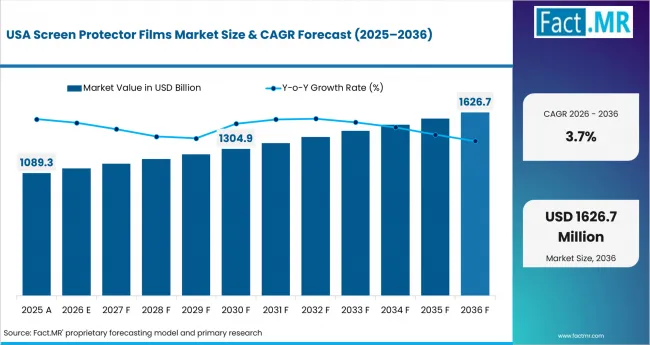
Screen Protector Films Market Country Value Analysis | Source: Fact.MR
United States buyers often purchase screen protection with a phone case, charger or warranty-linked accessory bundle. Pew Research Center reported in November 2025 that 91% of United States adults own a smartphone. [5] This high ownership base creates a steady replacement pool for films and privacy protectors. Channel gains depend on retail installation quality and bundle placement at device upgrade points.
Why does South Korea remain important?
3.6% CAGR, supported by foldable phones and display-material expertise.
South Korea is expected to post 3.6% CAGR through 2036 due to foldable device use and local display technology depth. Samsung Display said in July 2025 that its foldable OLED panel for Galaxy Z Fold7 was verified for 500,000 folds. [6] That durability focus supports TPU hydrogel and self-healing films that can bend without cracking. Suppliers with clean coating and precise cutting capability are better placed than traders that only resell standard films.
Why is Japan a steady film market?
3.2% CAGR, supported by premium phones and conservative replacement behavior.
Japan is forecast to grow at 3.2% CAGR through 2036 due to higher expectations for fit, clarity and installation reliability. The Statistics Bureau of Japan reported that smartphone use was 74.4% by device among internet users as of August 2024. [7] Buyers tend to prefer documented compatibility for specific device models. The country supports premium privacy and anti-glare variants more than broad discount packs.
What underpins Germany’s growth?
3.1% CAGR, supported by enterprise privacy needs and regulated workplace use.
Germany is projected to rise at 3.1% CAGR through 2036 due to enterprise laptop fleets and privacy-led purchasing. Eurostat reported that 78% of European Union internet users bought goods or services online in 2025. [8] That online buying base supports model-specific accessory sales and replacement orders. B2B buyers in Germany are likely to favor privacy filters and durable laptop films over very low-priced phone films.
How does the United Kingdom perform?
3.0% CAGR, supported by online accessory retail and mobile-work privacy needs.
The United Kingdom is expected to advance at 3.0% CAGR through 2036 due to online accessory buying and hybrid-work device use. Ofcom reported in December 2025 that United Kingdom smartphone users used an average of 41 apps in a month. [9] Demand is concentrated in smartphone protectors, laptop privacy films and tablet protection for education and field work. Suppliers that support both consumer e-commerce and office-device resellers can protect margins better than single-channel sellers.
Who leads the screen protector films landscape?
ZAGG and Belkin lead the brand layer. 3M, PanzerGlass and OtterBox shape privacy and accessory claims. Corning, Nitto Denko, Saint-Gobain and Nippon Electric Glass influence materials and glass-adjacent positioning.
Screen protector films are supplied by consumer accessory brands, optical film producers and glass-technology companies that influence protection claims. ZAGG supports on-demand screen protection for stores that need broad model coverage. Belkin International, PanzerGlass A/S, Otter Products LLC and Tech21 UK Ltd compete through device-specific accessories and warranty-linked programs.
In June 2024, Corning launched Gorilla Glass 7i for intermediate and value-segment smartphones. [11] Adjacent automotive mobile accessories also show how screen protection connects with aftermarket display and device-protection channels.
Competition through 2036 is expected to depend on model coverage speed, installation quality and credible claims. The European Commission made Corning commitments legally binding in July 2025 for cover glass used in handheld electronic devices. [10] This does not directly regulate screen films but it shows why buyers watch claims around display-protection materials. Recycled-content claims also connect screen protectors with PCR in consumer electronics when brands document the material source.
Which companies are the key players?
ZAGG, Belkin, 3M, PanzerGlass, OtterBox, Tech21, Corning, Nitto Denko, Saint-Gobain and Nippon Electric Glass.
- ZAGG
- Belkin International
- 3M Company
- PanzerGlass A/S
- Otter Products LLC
- Tech21 UK Ltd
Bibliography
- [1] International Telecommunication Union. (2024, November 10). Facts and Figures 2024: Subscriptions. International Telecommunication Union.
- [2] International Telecommunication Union. (2025, October 15). Mobile phone ownership. International Telecommunication Union.
- [3] Press Information Bureau, Government of India. (2025, September 18). Mobiles: Catalysts of India’s digital rise. Press Information Bureau, Government of India.
- [4] State Council of the People’s Republic of China. (2026, January 30). China’s electronic information manufacturing sector posts stable growth in 2025. English.gov.cn.
- [5] Pew Research Center. (2025, November 20). Mobile fact sheet. Pew Research Center.
- [6] Samsung Display Co., Ltd. (2025, July 22). Samsung Display’s foldable OLED panel proves durable through 500,000 folds. Samsung Display Co., Ltd.
- [7] Statistics Bureau, Ministry of Internal Affairs and Communications, Japan. (2025). Statistical handbook of Japan 2025. Statistics Bureau, Ministry of Internal Affairs and Communications, Japan.
- [8] European Commission. (2025). E-commerce statistics for individuals. European Commission.
- [9] Ofcom. (2025, December 10). Online Nation report 2025. Ofcom.
- [10] European Commission. (2025, July 18). Commission accepts commitments by Corning to ensure competition in the supply of cover glass for handheld electronic devices. European Commission.
- [11] Corning Incorporated. (2024, June 4). Corning launches Corning Gorilla Glass 7i. Corning Incorporated.
- [12] ZAGG. (2026). InvisibleShield on Demand. ZAGG.
This Report Addresses
- Strategic intelligence on screen protector films across product type, device type, function and channel.
- Segment analysis covering PET film, smartphones, scratch protection, e-commerce and East Asia.
- Regional outlook covering India, China, United States, South Korea, Japan, Germany and United Kingdom.
- Competitive analysis of ZAGG, Belkin International, 3M Company, PanzerGlass A/S, Otter Products LLC, Tech21 UK Ltd.
- Channel assessment covering OEM pre-applied films, e-commerce, telecom stores and repair chains.
- Material assessment covering PET film, TPU hydrogel film, privacy film and anti-glare film.
- Primary interviews, portfolio checks, official source review and channel validation support the forecast.
What does the screen protector films market cover?
Protective films for smartphones and tablets. Coverage also includes laptops, wearables and industrial touch screens.
The screen protector films market covers thin film products applied to display surfaces for scratch resistance and privacy. It also covers reflection control and fingerprint reduction. It includes PET and TPU hydrogel films used for smartphones, tablets, laptops, wearables, automotive displays and industrial human-machine interface screens. The market differs from built-in cover glass because the product is replaceable and sold through accessory channels or original equipment manufacturer pre-application programs.
What is included in the scope?
Screen protection films, channel installation kits and B2B display-integration films.
The scope includes film-based screen protectors sold through original equipment manufacturer pre-application and e-commerce. It also includes repair chains and telecom stores with B2B display integration. It covers film products used on smartphones, tablets, laptops, wearables, automotive displays, industrial HMI panels and gaming devices. Installation aids and cut-on-demand programs are included when they are sold with the film system.
What is excluded from the scope?
Rigid tempered glass-only protectors and built-in cover glass are excluded unless a film layer is sold separately.
The scope excludes cover glass supplied as part of device manufacturing. It excludes rigid tempered glass protectors that do not include a film laminate. It excludes phone cases, camera lens rings and display panels. It also excludes protective coatings applied during panel manufacturing when no replaceable screen film is sold.
How was the analysis built?
100+ sources, 40+ company portfolios, 25+ countries, 20+ channel checks.
- Primary Research:
- Primary research includes interviews with accessory distributors and repair-store buyers. It also covers telecom retail teams and B2B display integrators. Additional checks were held with film converters and e-commerce sellers.
- Desk Research:
- Desk research reviews official telecom data and company product pages. It also reviews government electronics releases and competition regulator records. Film material portfolios and display accessory catalogues support the segment view.
- Market-Sizing and Forecasting:
- Forecasting uses an installed-device approach with channel replacement assumptions. The 2026 value was reconciled against smartphone and tablet installed base signals, average film selling prices and company portfolio coverage.
- Data Validation and Update Cycle:
- Forecasts were checked against public device ownership figures, company product changes and screen-protection channel signals. The update cycle gives higher weight to official sources dated after January 2024 and current company pages.
Segmentation
What is the report’s scope and coverage?
| Attribute | Details |
|---|---|
| Quantitative Units | USD Billion in 2026 to USD Billion by 2036 at CAGR |
| Market Definition | Replaceable films applied to device and display surfaces for scratch, privacy, glare and fingerprint control |
| Product Type | PET Film, TPU Hydrogel Film, Tempered-Glass Compatible Film, Privacy Film, Anti-Glare Film, Blue-Light Film |
| Device Type | Smartphones, Tablets, Laptops, Wearables, Automotive Displays, Industrial HMI, Gaming Devices |
| Function | Scratch Protection, Privacy, Anti-Reflection, Impact Resistance, Fingerprint Resistance, Antimicrobial Surface |
| Channel | OEM Pre-Applied, Retail, E-Commerce, Aftermarket Repair, Telecom Stores, B2B Display Integration |
| Regions Covered | North America, Europe, East Asia, South Asia, Latin America, Middle East and Africa |
| Countries Covered | India, China, United States, South Korea, Japan, Germany and United Kingdom |
| Key Companies Profiled | ZAGG, Belkin International, 3M Company, PanzerGlass A/S, Otter Products LLC, Tech21 UK Ltd. |
| Forecast Period | 2026 to 2036 |
| Approach | Installed-device base, channel pricing, replacement intensity, company portfolio review and source triangulation |
Source: Fact.MR analysis. Updated Jun 25, 2026
How is the market segmented?
-
By Product Type:
- PET Film
- TPU Hydrogel Film
- Tempered-Glass Compatible Film
- Privacy Film
- Anti-Glare Film
- Blue-Light Film
-
By Device Type:
- Smartphones
- Tablets
- Laptops
- Wearables
- Automotive Displays
- Industrial HMI
- Gaming Devices
-
By Function:
- Scratch Protection
- Privacy
- Anti-Reflection
- Impact Resistance
- Fingerprint Resistance
- Antimicrobial Surface
-
By Channel:
- OEM Pre-Applied
- Retail
- E-Commerce
- Aftermarket Repair
- Telecom Stores
- B2B Display Integration
-
By Region:
- North America
- United States
- Canada
- Mexico
- Latin America
- Brazil
- Argentina
- Rest of Latin America
- Europe
- Germany
- United Kingdom
- France
- Italy
- Spain
- Rest of Europe
- Asia Pacific
- China
- India
- Japan
- South Korea
- ASEAN
- Middle East and Africa
- GCC Countries
- South Africa
- UAE
- Rest of Middle East and Africa
- North America
Frequently Asked Questions
Which product type leads the Screen Protector Films Market?
Which device type contributes the most demand?
Which function is most important for buyers?
Which sales channel leads in 2026?
Which region leads the Screen Protector Films Market?
Which country expands faster through 2036?
How does China perform in the Screen Protector Films Market?
How does the United States perform in the Screen Protector Films Market?
What limits faster adoption of film protectors?
What creates the strongest opportunity for suppliers?
Who worked on this report


Preview the report firsthand - request a free sample
Free SampleGet the brochure for pricing and purchase details
Download PDF